Best Glock 43X MOS Red Dots: Optic Fit, Footprints, and Carry Guide
A Confession Before We Begin...
I will admit something up front, because honesty is cheaper than pretending: I was slow to warm to red dots on carry pistols. For a long stretch I regarded them the way I regard most new things in the gun world, which is to say with folded arms, waiting for them to fail. Electronic sights on a defensive handgun struck me as one more battery-powered gadget between a shooter and his fundamentals.
The best red dots for the Glock 43X MOS are compact optics designed for slim concealed carry pistols. Popular choices include the Holosun 407K, Holosun 507K, Holosun EPS Carry, Shield RMSc, Swampfox Sentinel, and SIG RomeoZero. Before buying, however, it's important to understand the Glock 43X MOS optic cut, footprint compatibility, adapter plate requirements, and whether your chosen optic will work with your sights, mounting hardware, and holster.
I was wrong, and I have shot enough with them now to say so without flinching. A quality micro red dot on a pistol like the Glock 43X MOS lets you stay focused on the target instead of the front sight, shoot with real confidence at distances that make iron sights honest, and track exactly what your gun is doing through a fast string of fire. The technology stopped being a competition novelty years ago. It has earned its place on everyday carry guns, and the shooters still refusing to acknowledge that are doing so on principle rather than evidence. I know, because I was one of them.
The 43X MOS itself needs little introduction. It is small enough to vanish under a T-shirt, big enough to shoot like a serious pistol, and optics-ready from the factory. For a great many carriers it is the point where concealability and shootability finally stop arguing with each other.
But here is where the trouble starts, and where this article earns its keep: not every optic belongs on this pistol, and quite a few that appear to fit do not. The 43X MOS uses Glock's slimline MOS cut, not the larger double-stack MOS footprint, and that single fact has generated more confused returns and stripped screws than any other detail in the small-optic world. Choosing correctly means understanding footprints, adapter plates, and mounting hardware before you spend a dime, and then matching the optic to the way the pistol actually lives. A gun carried inside the waistband every day, marinating in sweat and lint, has different requirements than one that commutes between the safe and the range. Weight matters. Bulk matters. Battery arrangements matter more than the catalogs suggest.
The market offers several genuinely excellent options. The job is figuring out which one fits your pistol and your life, in that order.
Carriers who have not decided whether an optic fits their training style should compare Iron Sights vs. Red Dot for Beginners before changing their sights, holster, and maintenance routine.
Glock 43X MOS Optic Cut Explained
Let us kill the most expensive misconception first: the factory 43X MOS slide does not accept every micro red dot, no matter how small the optic looks in the photograph.
Glock's slimline MOS system is its own animal, distinct from the standard MOS cut on pistols like the Glock 19 MOS or 17 MOS. It was designed around the smaller optics intended for slim carry guns, and compatibility is determined by the optic's footprint, meaning the specific pattern of recoil lugs and screw holes on its underside, not by its overall dimensions. This is where first-time buyers get burned. An optic can be plenty small enough to perch on the slide and still require an adapter plate or entirely different hardware because its footprint does not match the cut beneath it.
So before any money changes hands, verify three things: the optic's footprint, whether an adapter plate is required for your combination, and which mounting screws the manufacturer specifies for that exact setup. This takes ten minutes of reading and saves you from poor fit, inadequate thread engagement, and the special embarrassment of an optic departing the slide at the range. Every one of those problems is avoidable, and every one of them happens weekly to people who skipped the homework.
For a broader evaluation of the pistol before adding an optic, this Glock 43X MOS Review covers the platform’s dimensions, shooting characteristics, concealed carry role, and optics-ready configuration.
Direct Mount vs. Adapter Plates
This question decides the purchase for a lot of 43X MOS owners, so it deserves a straight treatment.
The case for direct mounting is simple and sound. Fewer components between the optic and the slide means fewer things that can loosen, shift, or fail, and the optic typically sits a touch lower, which improves the relationship between the window and your backup irons. If two optics suit you equally and one mounts directly, the direct mount is the sensible pick. Simplicity has been winning arguments in the gun world for two centuries, and it is not about to stop.
That said, do not let anyone convince you that an adapter plate is a mark of shame. A quality plate, installed correctly with the right hardware, is an extremely durable mounting solution, and some of the most respected enclosed-emitter optics on the market ride on plates when fitted to this pistol. The plate is not the risk. The wrong plate, or the right plate with the wrong screws, is the risk.
And about those screws: pay attention here, because this is where installations actually go wrong. A screw that is too long can interfere with internal slide components. A screw that is too short will not engage enough thread to survive recoil, and recoil is patient. Follow the optic and plate manufacturer's instructions to the letter, use the specified torque, and resist the temptation to assume all small screws are interchangeable. They are not, and the people who learn this at the range learn it expensively.
Before comparing individual sights, understanding What “Optics Ready” Actually Means can help clarify why footprints, mounting plates, slide cuts, and sight alignment vary between handgun platforms.
Best Glock 43X MOS Red Dots Compared
|
Optic |
Footprint |
Enclosed |
Reticle |
Battery Access |
Best For |
|
Holosun 407K |
K Series |
No |
6 MOA Dot |
Side Tray |
Everyday concealed carry |
|
Holosun 507K |
K Series |
No |
Multi-Reticle |
Side Tray |
Maximum versatility |
|
Holosun EPS Carry |
K Series |
Yes |
Dot or MRS |
Side Tray |
Defensive carry in all weather |
|
Shield RMSc |
RMSc |
No |
Dot |
Bottom |
Direct-mount simplicity |
|
Swampfox Sentinel II |
RMSc |
No |
Dot |
Top/Side (model dependent) |
Budget-conscious buyers |
|
SIG RomeoZero |
RMSc |
No |
Dot |
Top |
Lightweight carry builds |
Every optic on this list has earned a following, and they did it by appealing to different people. Hunting for the single universally best optic is a fool's errand, and I say that having watched the argument run in circles for years. The productive question is which one complements the way you actually carry your Glock, and that question has a real answer.
Shooters who want to compare these slimline options with sights built for larger defensive handguns can review the Best Red Dots for Pistols by durability, battery access, reticle design, and carry practicality.
Holosun 407K
If a man walked up to the counter and demanded one recommendation that fits the widest range of concealed carriers, the Holosun 407K is probably the answer he would get, and he would not be poorly served by it.
The size pairs naturally with the 43X MOS, the side-loading battery tray means you replace the battery without removing the optic and re-zeroing, and Holosun's battery life has become the company's calling card for good reason. None of that is flashy. All of it matters every single day the gun is on your belt.
The 6 MOA dot is the detail worth understanding. Some buyers see a big dot and assume it is the crude option, when in fact it is the honest one for defensive work. A defensive pistol is not a precision instrument for ringing steel at 100 yards. It is a tool for hitting quickly at close distance under stress, and a large dot that your eye finds instantly during a fast draw serves that purpose better than a fine aiming point you have to hunt for. For most carriers, that is precisely the right trade, made on purpose.
Holosun 507K
The 507K takes the same foundation and adds Holosun's Multi-Reticle System, letting the shooter choose between a plain dot, a circle-dot combination, and other arrangements according to taste.
The circle-dot has genuine appeal for rapid acquisition, particularly for shooters newer to red dots, and plenty of experienced hands like it fine. Others start with the circle and gradually settle on the dot alone as their presentation matures, which is its own kind of education. Beyond the reticle options, the 507K shares the 407K's virtues: excellent battery life, solid durability, compact dimensions, and controls that do not require an engineering degree.
Which brings the decision down to a refreshingly simple question. Are the extra reticle choices worth the extra money to you? If yes, buy the 507K and enjoy it. If you know you are a plain-dot shooter, the 407K does the same job for less, and there is no dishonor in either answer.
Holosun EPS Carry
The EPS Carry became one of the most respected optics in the carry market in short order, and it did so by solving the open-emitter design's one honest weakness.
That weakness is the environment. An open-emitter optic leaves its little projector exposed to the world, and the world contains rain, sweat, dust, and pocket lint in quantities that must be experienced to be believed. Any of them can obstruct the emitter at an inconvenient moment. The EPS Carry seals the emitter and the optical system inside the housing, which removes the problem rather than managing it.
For someone who carries daily in a humid climate, works outdoors, or simply sleeps better knowing the dot will be there regardless of what the day threw at the gun, the enclosed design is a meaningful upgrade rather than a marketing flourish. The tradeoff is money. The EPS Carry commands a premium over comparable open-emitter optics, and whether that premium is justified depends on your climate, your habits, and your temperament. A good many experienced carriers have concluded that it is, and their reasoning is difficult to argue with.
Compatibility gets you to the starting line, but it is only the starting line. Once you have narrowed the field to optics that genuinely fit the slimline MOS cut, the real decision becomes weighing durability, window size, battery access, and reticle design against how the pistol actually gets carried. Those tradeoffs will matter to you for years. The newness of the optic will matter for about a month.
Shield RMSc
The Shield RMSc deserves respect for a simple reason: it helped establish the footprint that much of this category still uses, which makes it something of an elder statesman among small optics.
Its virtue is restraint. The RMSc is compact, light, and built specifically for slim carry pistols, and it blends into the 43X so cleanly that the slide never develops that top-heavy feel some optics impose on a thin gun. There is a certain satisfaction in equipment that does its job without announcing itself, and the RMSc has it.
The concession to its age is the battery arrangement. Some RMSc models load from the bottom, which means removing the optic to change the battery and confirming your zero afterward. This is not a catastrophe, and shooters managed it without complaint for years, but it is undeniably less convenient than the side-loading trays on newer designs. Whether that bothers you is a matter of temperament. For the shooter who values a proven footprint and a clean, minimalist package over the latest conveniences, the RMSc remains an entirely sound choice.
Swampfox Sentinel II
Swampfox has built its following the old-fashioned way, by delivering more optic than the price suggests, and the Sentinel II carries that flag capably.
It fits the 43X MOS, the brightness controls are sensible, and the viewing window is generous for the size class. What Swampfox does not have is decades of institutional reputation, because no young company does, and there is no substitute for time in this business. But a considerable number of everyday carriers have run Sentinels hard and come away satisfied, and that record is accumulating in the only way records can.
The point worth taking is that budget-conscious and low quality stopped being synonyms some years back. The Sentinel II occupies the sensible middle ground where a buyer gets most of the modern features without paying enclosed-emitter money, and for a lot of people that is exactly the right place to shop.
SIG RomeoZero
The RomeoZero is one of the lightest optics you can bolt to a slim carry pistol, and for the shooter waging war against every ounce on the belt, that is its whole argument, honestly made.
The polymer housing is how it achieves that weight, and polymer is also why the RomeoZero is not built to absorb punishment the way the aluminum-bodied competition is. This is not a criticism so much as a description. The optic was designed for lightweight daily carry, not for hard duty use, and judged on its intended purpose it performs respectably.
The same rule applies here as everywhere else in this article: evaluate the optic against how you will actually carry and use the pistol, not against a specification sheet or somebody else's priorities. A spec sheet has never once been attacked in a parking lot.
Open Emitter vs. Enclosed Emitter
Strip away the brand loyalties and this is the biggest genuine decision in front of today's buyer, so let us take it seriously.
Open-emitter optics have owned this market for years, and they earned it honestly. They are lighter, less expensive, and perform extremely well, which is why they remain the most common choice on everyday carry guns. Their one weakness is exposure. The emitter sits open to the elements, and moisture, dust, or lint can occasionally block the projected dot if the optic goes uninspected. For most carriers this never amounts to anything, because a quick glance at the optic before holstering catches the problem while it is still trivial. A daily equipment check is a habit worth having anyway, red dot or not.
Enclosed-emitter designs like the EPS Carry seal the whole works inside the housing, trading a little money and, in some cases, a little size for immunity to the lint-and-sweat problem. That trade has been winning converts steadily, particularly among people in humid climates and people who spend real time outdoors.
Neither answer is wrong. The open emitter asks slightly more diligence of you. The enclosed emitter asks slightly more money. Know which currency you would rather spend, and you have your answer.
Dot Size, Reticles, and Window Size
Here is an assumption that needs correcting: the smallest dot does not automatically make you the most accurate, and on a defensive pistol it can work against you.
A larger 6 MOA dot is easier for the eye to find during a fast draw, which makes it genuinely effective inside the distances where a concealed carry pistol earns its keep. A smaller dot buys precision at longer range at the cost of demanding more visual discipline under stress, and stress is famously stingy with visual discipline. Precision you cannot find quickly is not precision. It is decoration.
Multi-reticle systems like the 507K's split the difference, offering a circle-dot for fast acquisition and a plain dot for the traditionalists, and letting the shooter change his mind as experience accumulates. That flexibility has real value, particularly for shooters still learning what their eye prefers.
Window size deserves the same honest accounting. A larger window makes tracking the dot through recoil easier, which new red dot shooters appreciate, but larger windows come attached to larger optics, and this pistol was purchased specifically because it is thin. The right answer is the balance point, not the biggest lens in the case, and the balance point is personal.
Battery Life, Controls, and Durability
Battery technology in this category has improved to a degree that those of us who remember the early electronic sights find mildly astonishing. Quality carry optics now measure battery life in years, particularly with auto-brightness or motion-activated wake features doing the housekeeping.
Side-loading battery trays have become the standard for a good reason: changing a battery without removing the optic means changing a battery without disturbing your zero, and anything that protects a zero is a friend of mine. Brightness controls matter more than they get credit for as well. An optic that fights you when moving between an indoor range, bright sunlight, and a dark parking garage becomes an irritation, and irritating equipment gets left home. The reputable makers have largely solved this, but confirm it before buying rather than after.
On durability, I will give you the counsel I gave across the counter for years: this is the easiest place in the whole purchase to justify spending a little more. A carry optic lives a harder life than any range toy, absorbing constant movement, repeated recoil, sweat, temperature swings, and the occasional introduction to a door frame or seat belt buckle. Three years from now, a robust housing and proven electronics will be worth far more to you than whatever extra feature tipped you toward the fragile option. Buy the sturdy one. You will forget the price and remember the reliability.
Co-Witness and Backup Sights
Mounting a red dot does not retire your iron sights, and it should not. The two systems are colleagues, not rivals, and the irons are the ones that never need a battery.
Most 43X MOS owners settle on a lower-third co-witness, where the irons remain visible through the bottom of the optic window without cluttering the sight picture. The dot runs the show, and the irons stand quiet watch underneath it, which is exactly the arrangement you want.
Whether your factory-height sights achieve that depends on the optic, the mounting solution, and any adapter plate in the stack. Some combinations deliver a workable picture straight away. Others need suppressor-height sights to lift the irons into the window. The mistake to avoid is assuming, because every combination is its own case. Verify the complete setup, optic and plate and sights together, before buying additional components, and you will buy them once instead of twice.
Zeroing and Routine Maintenance
Installing the optic is not the finish line. It is the starting gun, and treating it otherwise is how people end up carrying an unzeroed pistol with great confidence, which is a worse condition than carrying no optic at all.
Zero the optic properly before trusting it for anything defensive. Most shooters establish an initial zero at a common defensive distance and then confirm performance closer and farther, which is sensible practice. Then keep confirming over time, because recoil, maintenance, and battery changes all provide honest reasons to verify point of impact at future range sessions. A zero is not a certificate you earn once. It is a claim you keep checking.
Give the mounting screws the same periodic attention. Manufacturers publish torque values and thread-locking procedures for a reason, and following those recommendations, along with occasionally confirming the screws remain secure, keeps small issues from maturing into large ones. And build the five-second habit that costs nothing: before the gun goes on your belt, glance at the optic. Lens clean, dot lit, no lint colony establishing itself in the window. It is the cheapest insurance in this entire article.
Carrying a Glock 43X MOS With a Red Dot
Here is the pleasant surprise waiting for most new red dot carriers: the optic barely affects concealment at all.
The part of a pistol that prints under clothing is the grip, always has been, and the optic rides above the belt line where it contributes remarkably little to your silhouette when the holster is designed for it. The shooters who agonize over whether an optic will give them away are worrying about the wrong end of the gun.
What actually matters is consistency. The optic must present cleanly during the draw without snagging cover garments, and the holster must accommodate the optic fully while keeping its retention on the pistol itself. Give it a little honest practice and drawing the optics-equipped gun becomes exactly as natural as drawing the iron-sighted one. The hand does not know the difference. Only the results do.
Once the optic has been selected, this guide to Glock 43X MOS Accessories explains how sights, magazines, grip improvements, and carry equipment affect the complete setup.
Choosing an Optic-Ready Holster
Adding a red dot obligates you to confirm your holster accepts one, and this is not the place to gamble on "probably."
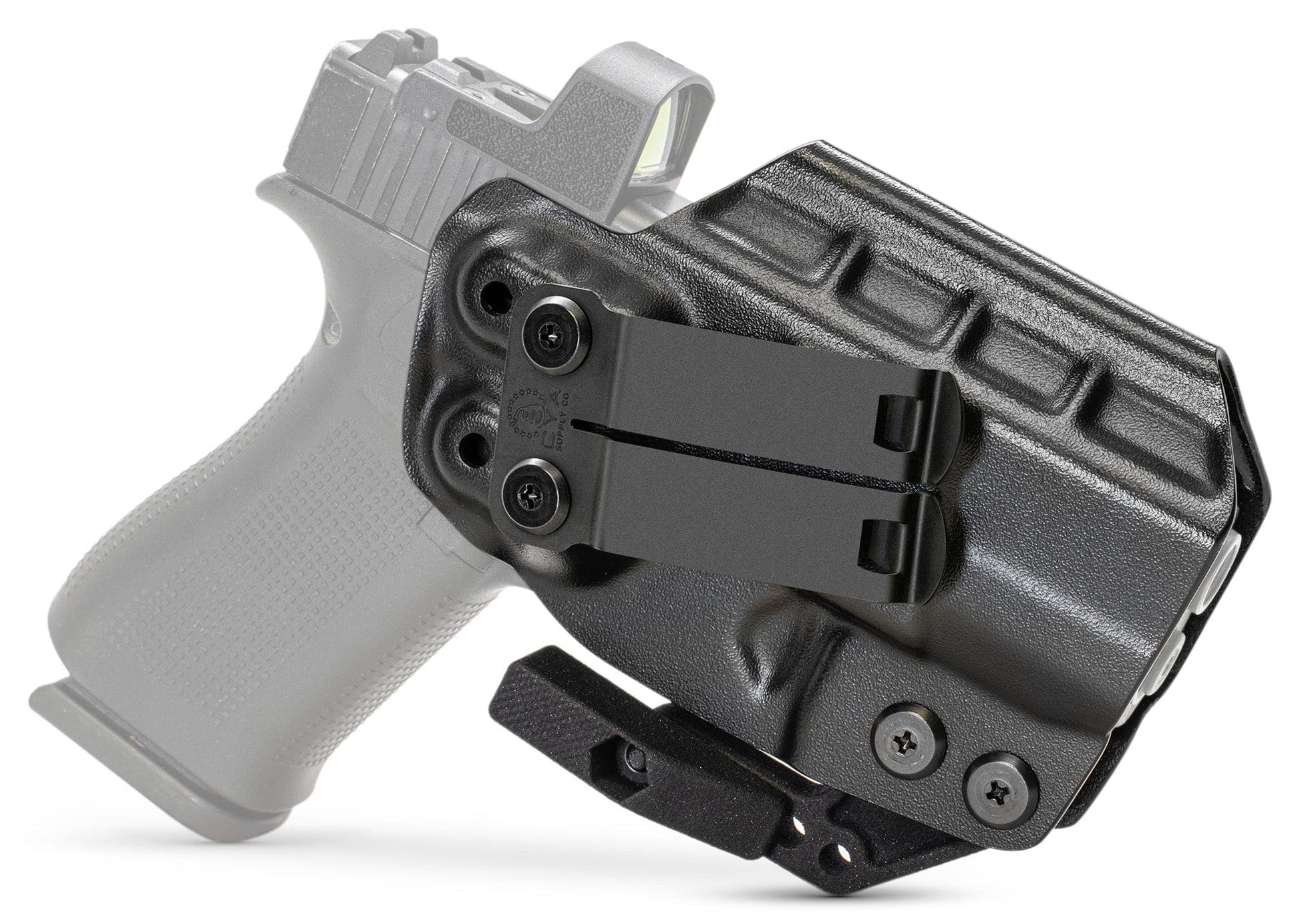
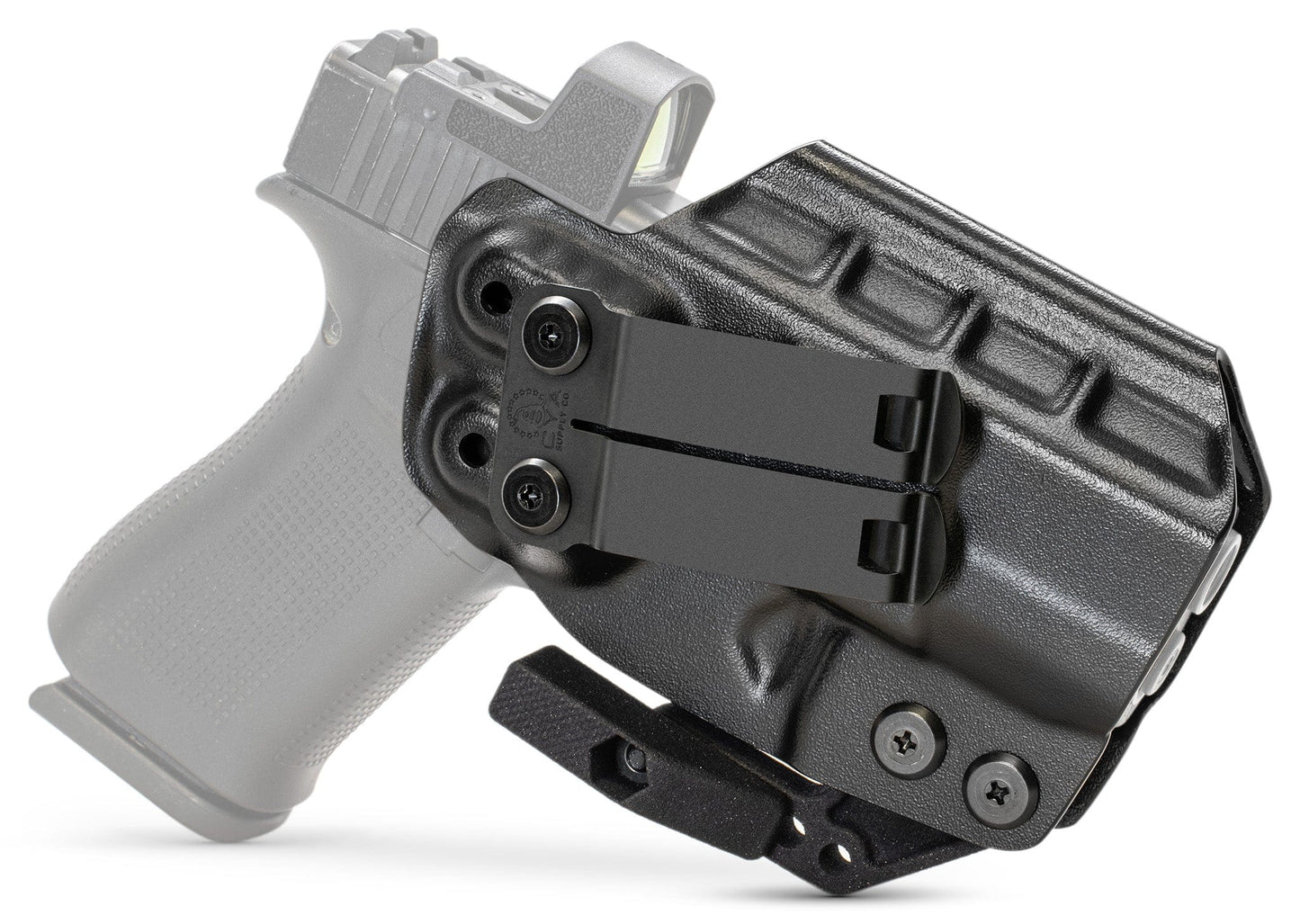
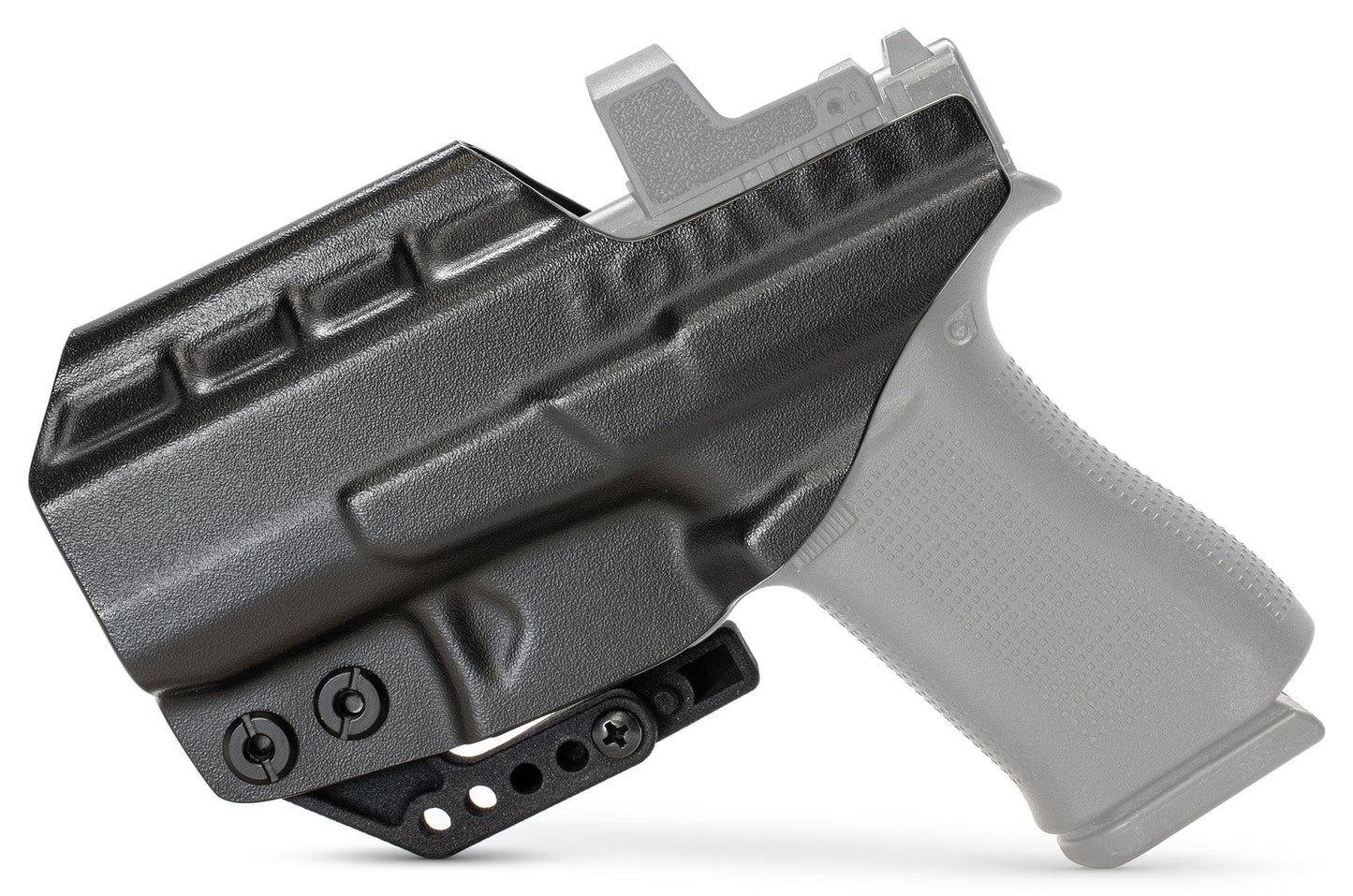
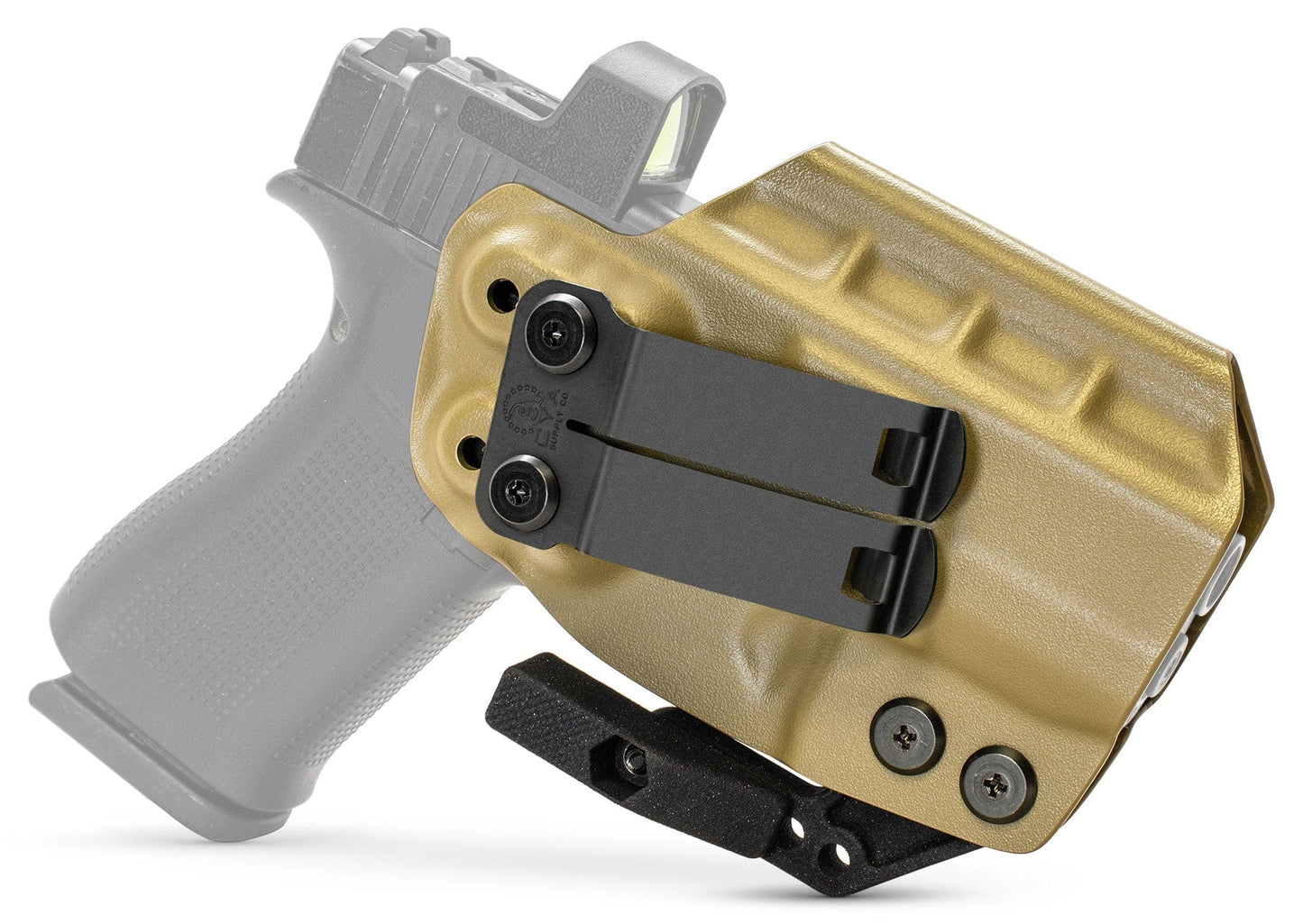
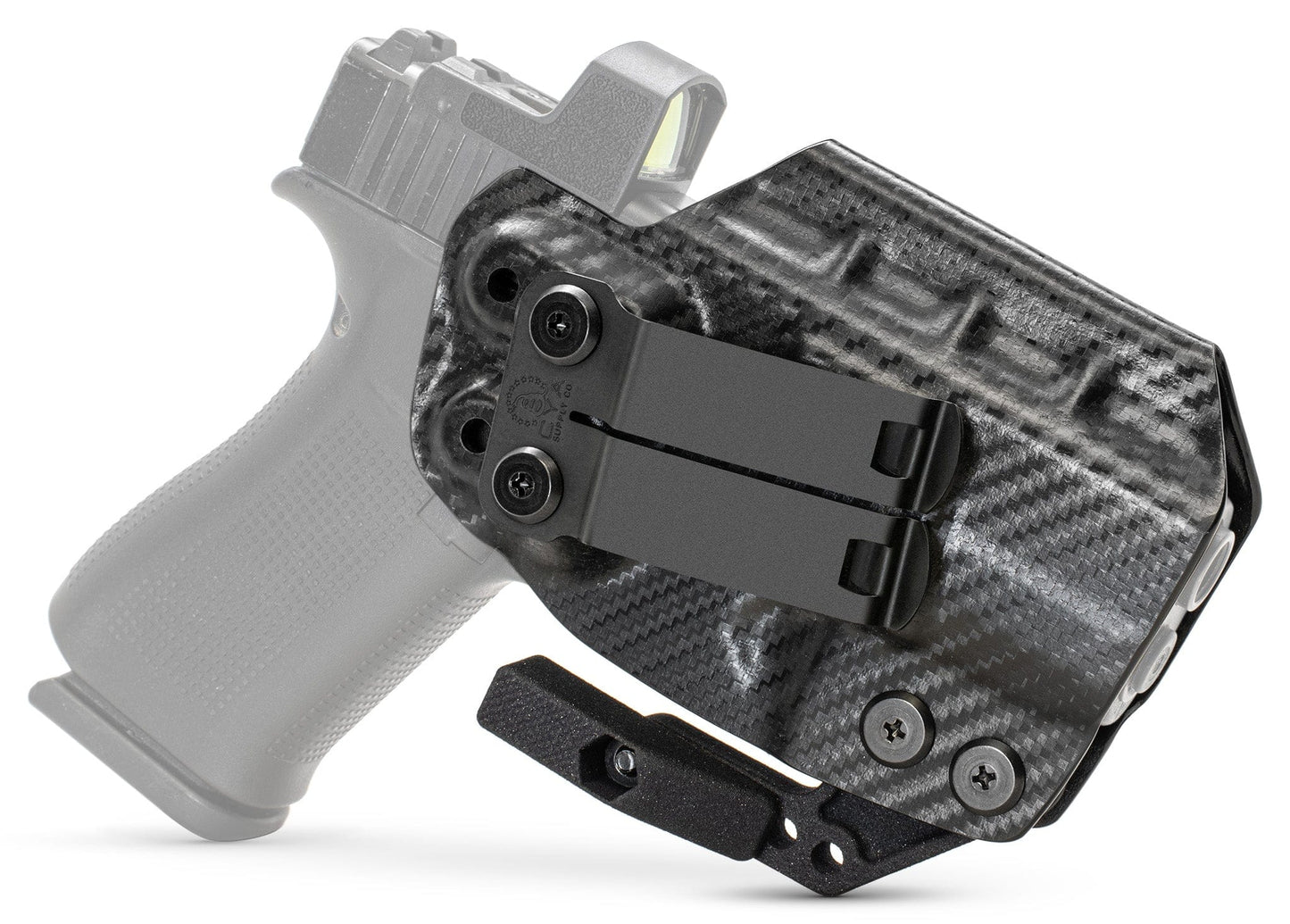
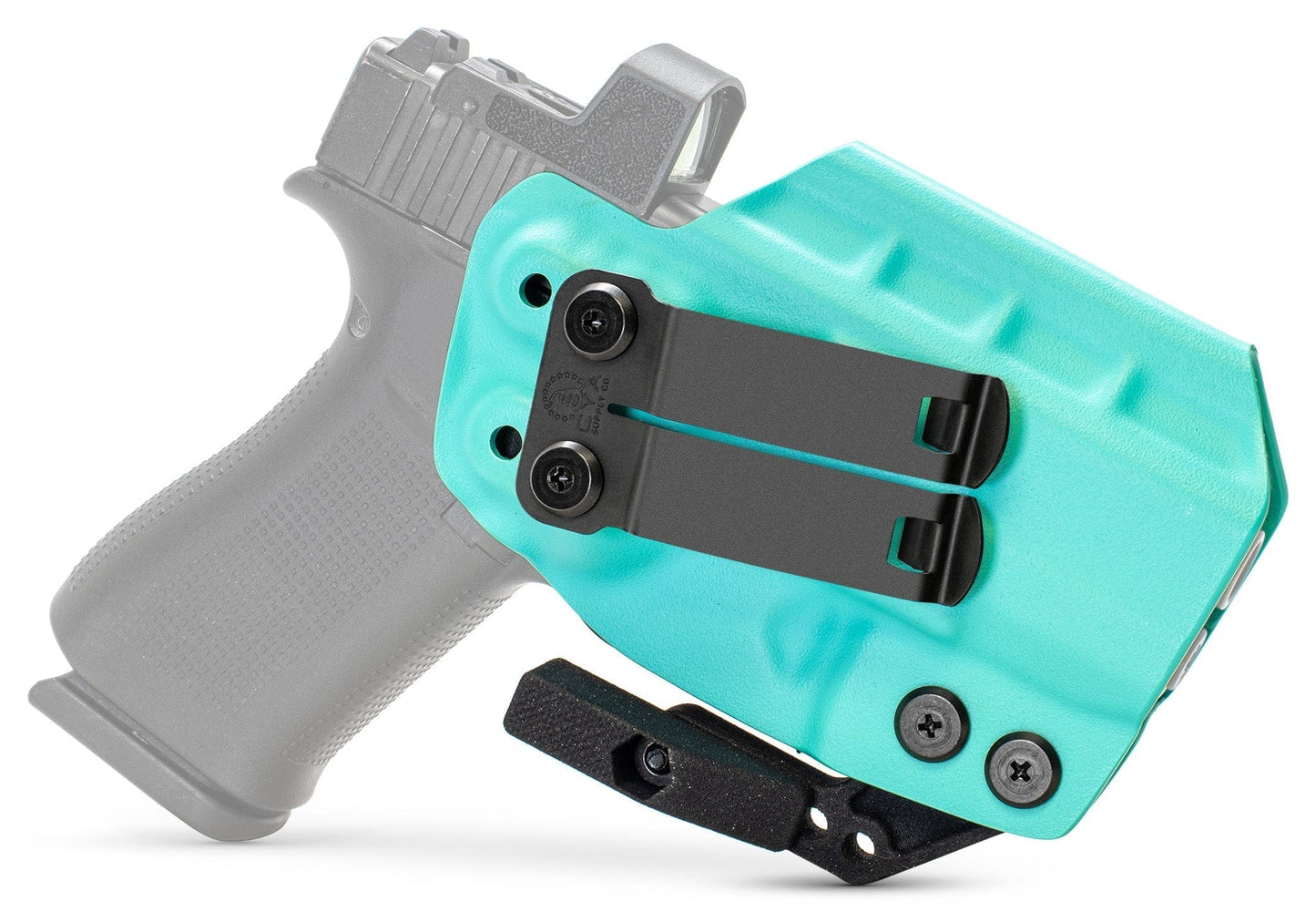
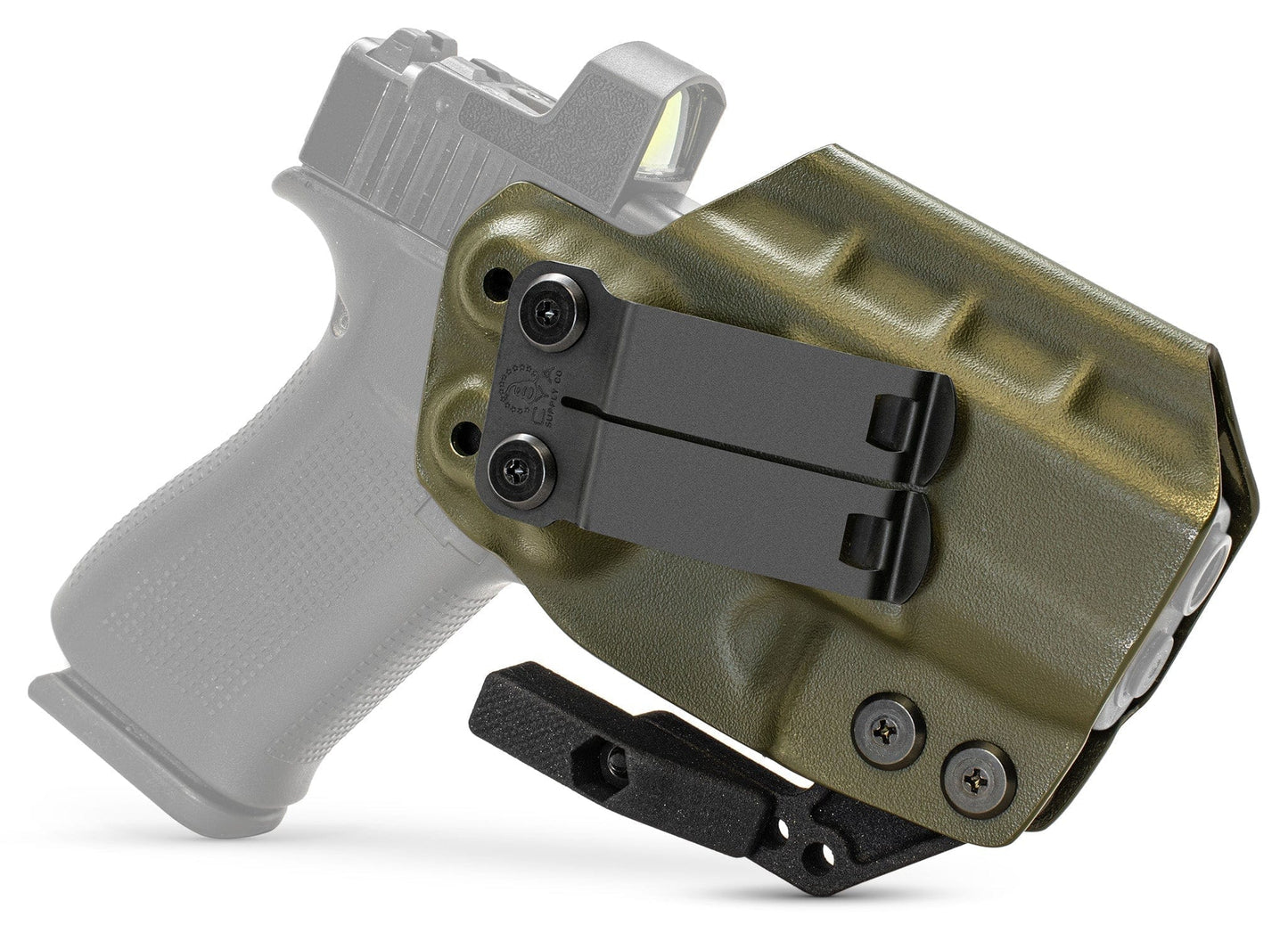
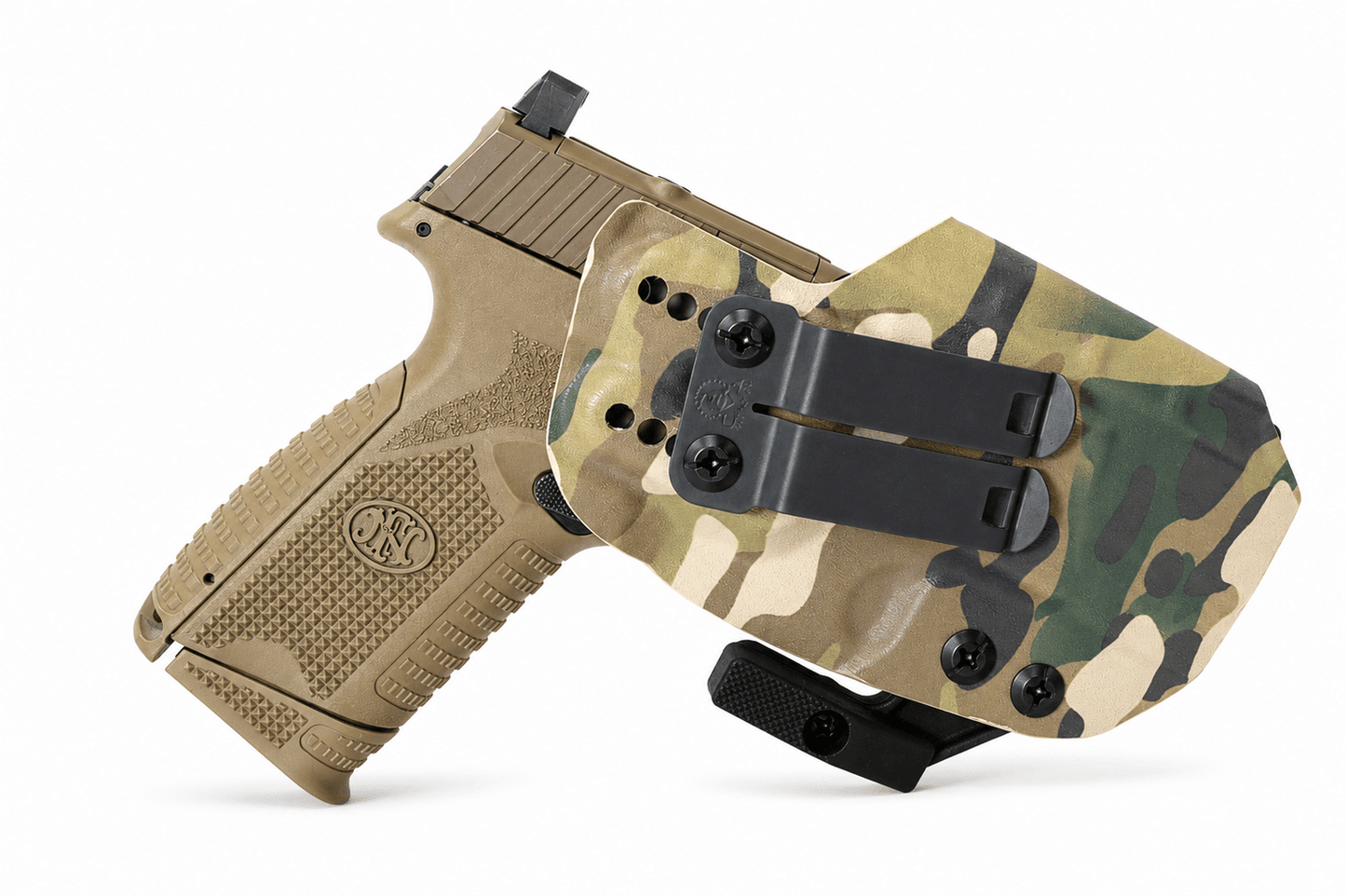
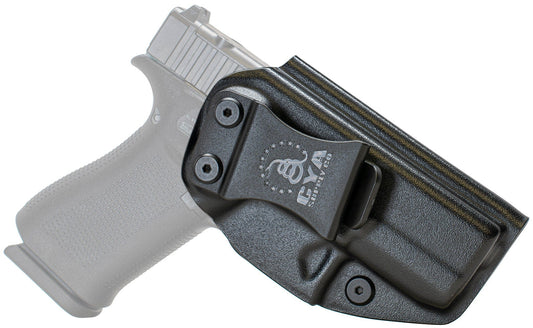
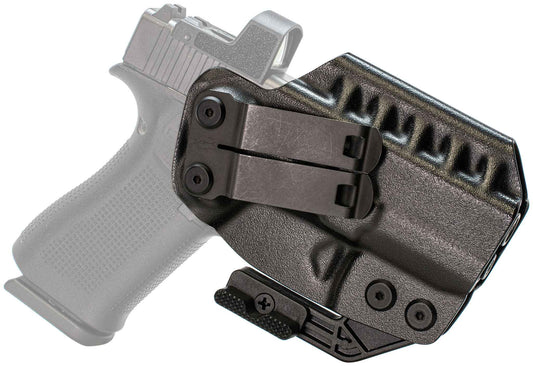
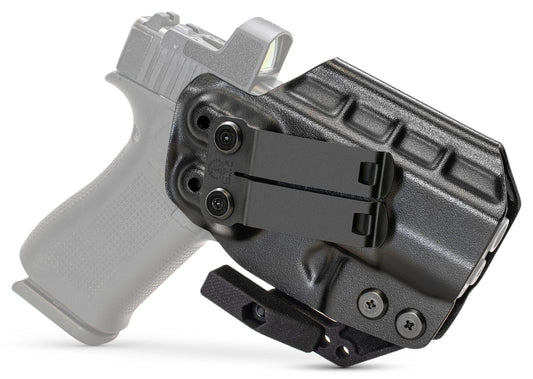
The good news is that most modern holsters built for the Glock 43X MOS already include optic clearance, but verify it before purchasing rather than discovering the answer with a mounted optic and a holster that will not take it. A proper optic-ready holster covers the trigger guard completely, retains the pistol consistently regardless of the optic, clears common micro red dots without contact, keeps its sweat guard out of the optic's way, and delivers the same smooth draw stroke every single time. A holster that does four of those five things is not eighty percent of a holster. It is a problem you paid for.
If you run a weapon light, treat that as its own compatibility question. Light-bearing holsters are molded around the pistol and the specific light together, so the fit depends on the complete combination, not the gun alone. Assume nothing, confirm everything, and you will buy the right holster the first time.
The Best Holster for Glock 43X MOS guide explains how optic clearance, grip tuck, retention, ride height, and belt stability work together in an everyday carry setup.
Final Thoughts
The Glock 43X MOS is one of the finest factory optics-ready carry pistols money currently buys, and the right red dot genuinely expands what it can do. The discipline is resisting the urge to shop by popularity or price tag alone, because neither one mounts to a slide.
Start with compatibility, always. Confirm the optic fits the slimline MOS cut, understand whether your combination needs an adapter plate or particular hardware, and verify that sights, optic, and holster function as one system rather than three purchases. After that, the decision turns personal, and the personal decisions are the enjoyable ones. The Holosun 407K remains the strongest all-around answer for everyday carry, combining durability, long battery life, and practical simplicity. The 507K adds reticle flexibility for those who want it, and the EPS Carry offers enclosed-emitter confidence for those willing to pay for it. The Shield RMSc, Swampfox Sentinel II, and SIG RomeoZero each serve their own constituencies honorably, which is precisely why no single "best" optic exists, no matter how many headlines claim otherwise.
Whichever you choose, put in the training. I will spare you the full sermon and give you the short version: a red dot is not a substitute for fundamentals, and it never will be, but in practiced hands it helps you shoot faster, track the gun through recoil, and wring more out of one of the most capable carry pistols on the market. Pair it with an optic-ready holster built specifically for the 43X MOS, and you have a carry system assembled the way systems ought to be assembled, which is deliberately, and all the way through.
Frequently Asked Questions
What red dots fit the Glock 43X MOS? Popular options include the Holosun 407K, Holosun 507K, Holosun EPS Carry, Shield RMSc, Swampfox Sentinel II, and SIG RomeoZero. Some mount directly, while others require an adapter plate or specific mounting hardware.
Does the Glock 43X MOS use the same optic cut as a Glock 19 MOS? No. The Glock 43X MOS uses Glock's slimline MOS cut, which differs from the standard double-stack MOS footprint found on pistols like the Glock 19 MOS and Glock 17 MOS.
Is an enclosed-emitter optic worth it? For many concealed carriers, yes. Enclosed-emitter optics provide additional protection against sweat, lint, moisture, and debris, making them especially appealing for daily carry.
Will factory sights co-witness with a red dot? It depends on the optic and mounting solution. Some combinations work with factory-height sights, while others require suppressor-height sights to achieve a lower-third co-witness.
How often should I replace the battery? Follow the optic manufacturer's recommendations. Many experienced carriers replace batteries on a regular schedule rather than waiting for the battery to fail.
Do I need a new holster after adding a red dot? If your current holster isn't optics-ready, you'll likely need one that provides proper optic clearance while maintaining secure retention and complete trigger guard coverage.
Does a red dot make concealed carry harder? Not usually. The optic adds very little to overall printing because it sits above the belt line. Proper holster design has a much greater impact on concealment than the optic itself.

Justin Hunold
Wilderness/Outdoors Expert
Justin Hunold is a seasoned outdoor writer and content specialist with CYA Supply. Justin's expertise lies in crafting engaging and informative content that resonates with many audiences, and provides a wealth of knowledge and advice to assist readers of all skill levels.